CPA Guide: Save Time, Money, & IRS Stress with a Tax Accountant for Tax Preparation
Disclaimer: My goal in these articles is to simplify the complex and help you take the next step in your financial situation. As such, this is not a comprehensive deep dive into every possible nuance or strategy. This article, like all my resources, is intended solely for educational purposes and should not substitute for specific investment, financial, or tax advice. Always consult a qualified tax professional for guidance about your tax situation.
💡 Key Takeaways - Tl;dr:
Tax Prep is Hard: It’s Complicated, Time-consuming, Errors and Mistakes are Expensive, Tax Bills are High, and Audits are Intimidating and Expensive
A Tax Accountant Should: Save you Time, Money, Stress, and help you Avoid IRS Audits
Step 1: Determine Whether You Need a Tax Accountant. How complex is your situation? Do you understand your taxes? How much work do you have? Do you have any “special” tax situations?
Step 2: How to Find a Qualified Tax Accountant. Ask for Referrals, check the IRS Directory, Google, and Reviews.
Step 3: Vetting your Tax Accountant. Once you’ve found one, vet them to understand their Expertise, Services, Experience, Capacity, Fees, Tax Planning, License, Insurance, Representation, Communication, & Technology.
Step 4: Building a Relationship with Your Tax Accountant. Ensure Honesty and Transparency, Ask for Advice when needed, and Share your Goals and Plans.
Step 5: Prepare for Your Tax Engagement. Save Time & Money by Preparing your Tax Documents for your Tax Accountant with Checklists and Organizers.
Step 6: Understand Important Deadlines. Understand your Filing Deadlines and ensure your Tax Accountant has enough Information and Time to File Returns.
Tax Organizers and Preparation Checklists for working with your Tax Accountant for Personal & Business Tax Preparation
My central assumption in this guide: you want to optimize your earnings, minimize taxes, and simplify tax filing to reduce IRS stress as much as possible.
This article is one among many in my tax planning series that aims to help you do just that.
Why is Tax Preparation so Challenging?
Have you ever asked yourself that question? I ask it… every year at tax time… and I’ve been doing this for well over a decade now.
Here’s the problem as I see it:
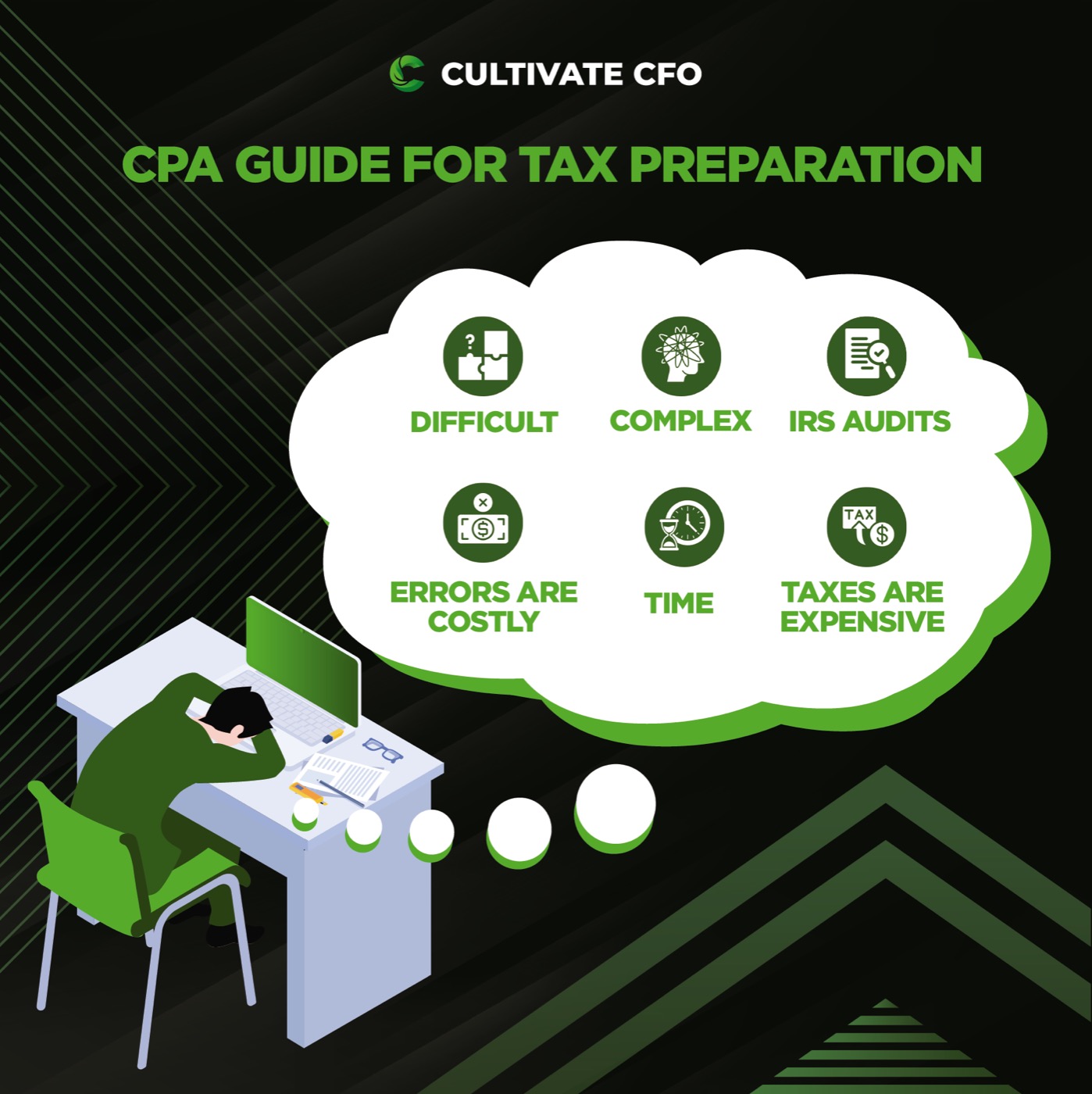
- Tax Prep is Daunting. It requires a highly specialized skillset that most lack and wouldn’t benefit from learning if they wanted to.
- Taxes are Overly Complicated. Think about all the chaos in Washington, then imagine distilling that mess into an interconnected web of laws and regulations and then untangle what that mess means to your tax liability.
- Learning all the Regulations takes too much Time. Your time is better spent elsewhere making money and bringing value in your area of expertise. The reality is that doing it yourself often costs more in errors and time than it saves.
- Errors are Costly. Not only do you get penalties and interest, but if you file incorrectly, you may invalidate a tax strategy and tax savings. Incorrectly filed tax returns are also difficult and expensive to amend.
- Taxes are Expensive. One of the biggest expenses in your business and life is your tax bill. Not knowing how to file correctly will likely compound what you owe in taxes.
- Tax Audits Suck. The fear of an IRS audit ranks up there with the fear of a terminal disease diagnosis. Going through an audit is stressful and costly in advisor fees and tax bills in bringing about a resolution.
- Tax Accountants Can’t Do it All. Even if you work with a Tax Accountant, you still have to gather your documents and provide accurate information… you can’t get out of this work!
- Misconception about Tax Accountants and Tax Savings. Keep in mind, not all tax preparers do tax planning, and when you pay for tax preparation, you are not paying for tax planning. If you have done tax planning, it is essential that your Tax Accountant understands your tax planning strategies and is able to implement them effectively.
That all sounds miserable, but this article is my guide to help you through to successfully file your tax returns with as little stress as possible.
Why Trust Me?
As a licensed CPA with over a decade of experience handling a broad range of tax returns. My firm has hundreds of clients ranging from simple 1040’s to complex Partnership and Corporation returns.
We are right now getting into the swing of tax season, meeting with our clients to help them prepare their tax filings.
As you are needing to prepare for your tax return filings, I want to guide you through our process. I’ll provide you tools and checklists to work successfully with your Tax Accountant this tax season.
Your goals in partnering with a qualified Tax Accountant or CPA should be to:
- Save time - so you can focus on building your business and making money.
- Save money - save on taxes and avoid costly errors.
- Save Stress - avoid having to delve into the complexities of the tax code yourself and let someone else do it faster and more accurately.
- Avoid IRS Audits - don’t set yourself for unnecessary IRS notices and audits by making mistakes, and partner with an expert for representation if needed.
In this article, I’m going to help you complete the following steps for a successful tax season:
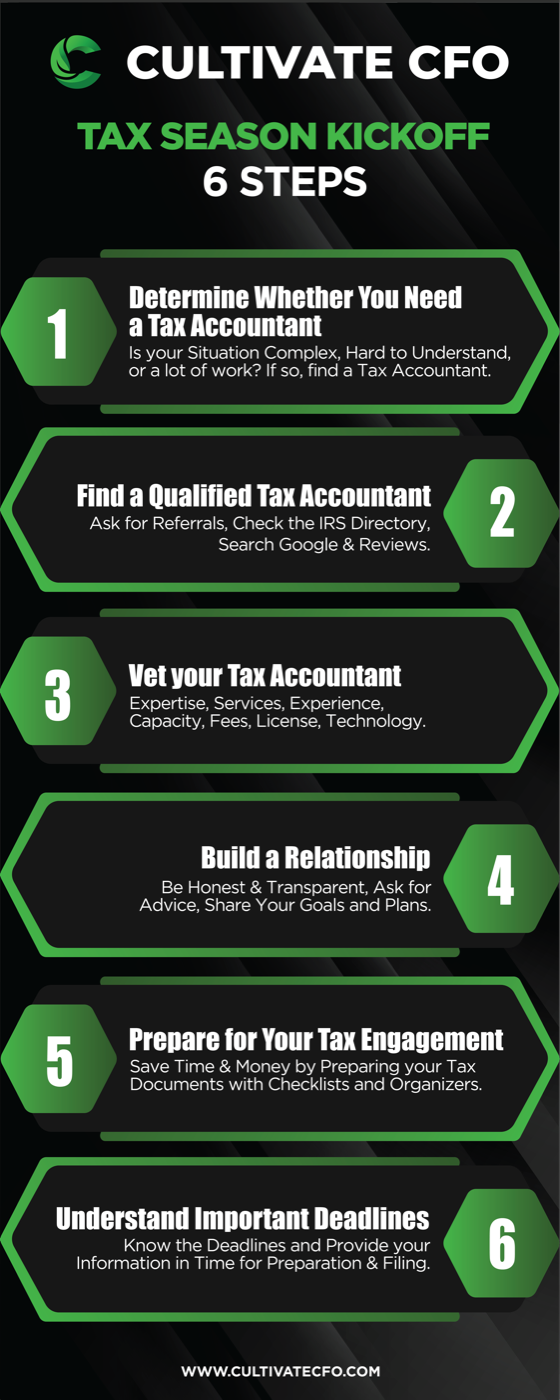
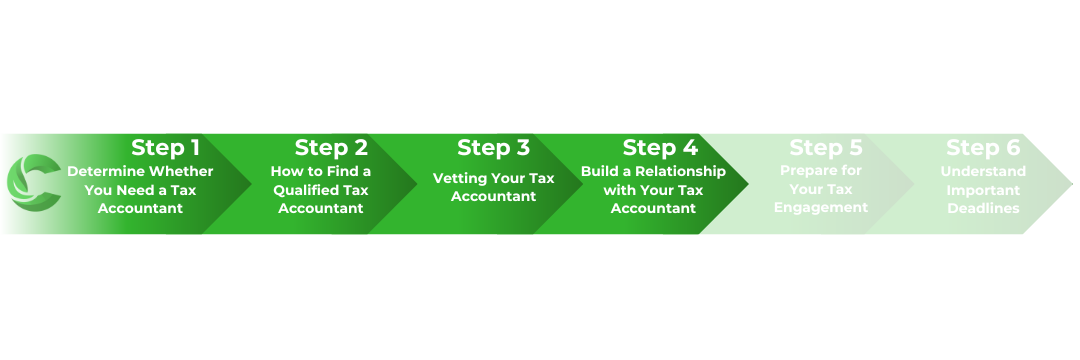
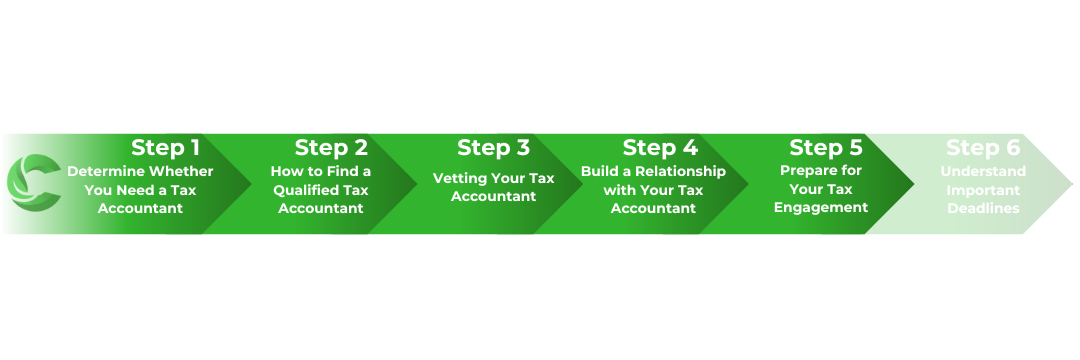
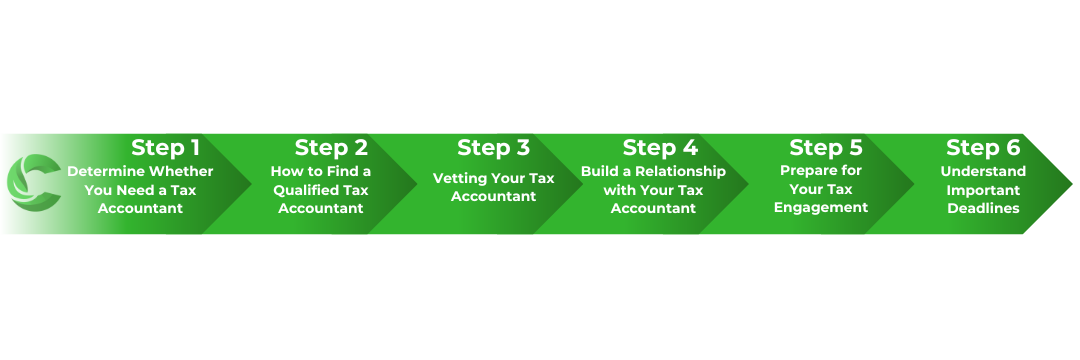
- Step 1: Determine Whether You Need a Tax Accountant
- Step 2: Find a Qualified Tax Accountant
- Step 3: Vet your Tax Accountant
- Step 4: Build a Relationship with Your Tax Accountant
- Step 5: Prepare for Your Tax Engagement
- Step 6: Understand Important Deadlines
- Prepare using Tax Prep Checklists and Organizers
Step 1: Determine Whether You Need a Tax Accountant
Answer these 4 questions to determine if you even need a Tax Accountant, or whether you should self-file with software or bring to a fast-file company.
How complex is your situation?
There have been times when I have advised potential clients with simple filings that they will be better served by TurboTax or H&R Block than by my firm. The truth is their situation is simple and there isn’t much I can do to offer value to them. My fees will be too high and my CPA skillset is not necessary and can’t be leveraged to save them money on their taxes. On the other hand, if you have multiple schedules or a Partnership, S Corporation, or C Corporation tax return, I’d recommend engaging a Tax Accountant.
Ask yourself the following questions:
- How many tax forms have you received?
- Do you know how to process each of them?
How well do you understand your taxes?
If your returns are simple, and if you are familiar with your tax returns and have a good grasp on what is required, you may be better off filing your own returns.
When you review your prior year tax returns, can you tell if they are correct or not?
If your understanding is limited or if you have received a tax form you aren’t familiar with, you are better to engage a Tax Accountant. At the same time, have them walk you through the returns when they are complete so you can build your knowledge - it will serve you well in the future!
How much tax work do you have?
The amount of tax work you have to do is based on the complexity of your situation. If you have more than a 1040 and a few schedules, this can become overwhelming with the details involved in preparing and linking the tax forms.
Tax software can certainly help, but without a deeper knowledge of these forms, it can be difficult to verify that everything has been prepared correctly.
Do you have any of the following special situations?
If you have the following situations, engaging a Tax Accountant is a good idea:
- Schedule C Self Employment Income
- Schedule E Rental Property Income
- Schedule F Farm Income
- Complex Investment or Royalty Income
- Foreign Income, Assets, and Bank Accounts
- Asset Sale with Capital Gains or Losses
- Real Estate Transactions
- Early Retirement Distributions
- Cryptocurrency Transactions
- Tax Credits
- Complex K-1s
- Charitable Contributions of Property
- Stock Options or Equity Compensation
- Debt Forgiveness
- Natural Disaster Losses
- Multiple State Filings
- IRS Audit, Notices, Back Taxes, or Debt Resolution
- Amending Prior Year Returns
- Major Life Changes like Marriage, Divorce, or Death
- Business Tax Returns - 1065, 1120S, 1120
- Inheritance, Gift, and Estate Taxes
Ok, let’s assume you made it through this list and your answer is, “Yes, I need a Tax Accountant.” The next step is finding one.
Step 2: How to Find a Qualified Tax Accountant
Before diving into how to find a Tax Accountant, it's crucial to understand the reality that anyone can call themselves a tax preparer without specific qualifications. This lack or regulation led to the IRS to attempt to enforce qualification requirements back in 2011, which was ultimately struck down in court (more on this debacle).
Despite this setback, the IRS hasn’t been shy about warning against those they consider to be unqualified. Every year they release what they call the “Dirty Dozen” to warn against “unscrupulous tax return preparers.” They warn that “shady tax preparers” may:
- Refuse to sign the tax return or ask people to sign a blank return.
- Charge a fee based on the size of the refund.
- Ask for a cash only payment without providing a receipt.
- Invent false income to try to get their clients more tax credits.
- Claim fake deductions to boost the size of the refund.
- Direct refunds into their bank account, not the taxpayer's account.
A Revealing Customer Support Call
A few tax seasons ago, I had an enlightening conversation with a lead customer support manager at a well known tax software company about tax preparer qualifications. I called in to resolve a problem with a specific tax form not populating correctly, which they were able to promptly address.
However, the conversation then took an unexpected turn when I asked him about the kinds of support calls they receive from other tax preparers.
His answer was both surprising and unsettling. The majority of tax preparers who called in weren’t actually struggling with the software at all. Instead, they called in because they had no idea how to file the correct forms for their clients’ specific situations. Despite being tax preparers and presenting to the public as tax experts, they often sought tax advice from his customer support team, who was not equipped or able to provide it.
The insight here is clear: Many unlicensed tax preparers lack sufficient knowledge, training, and problem-solving skills to correctly file more than the simplest of tax returns. This is an area where you need an expert.
How do you find a Qualified Tax Accountant?
I’ll start with some advice direct from the IRS. The IRS provides a pretty good guide to help you Understand Credentials for Tax Preparers. Here’s the breakdown of the three credentials they recommend for a qualified Tax Accountant:
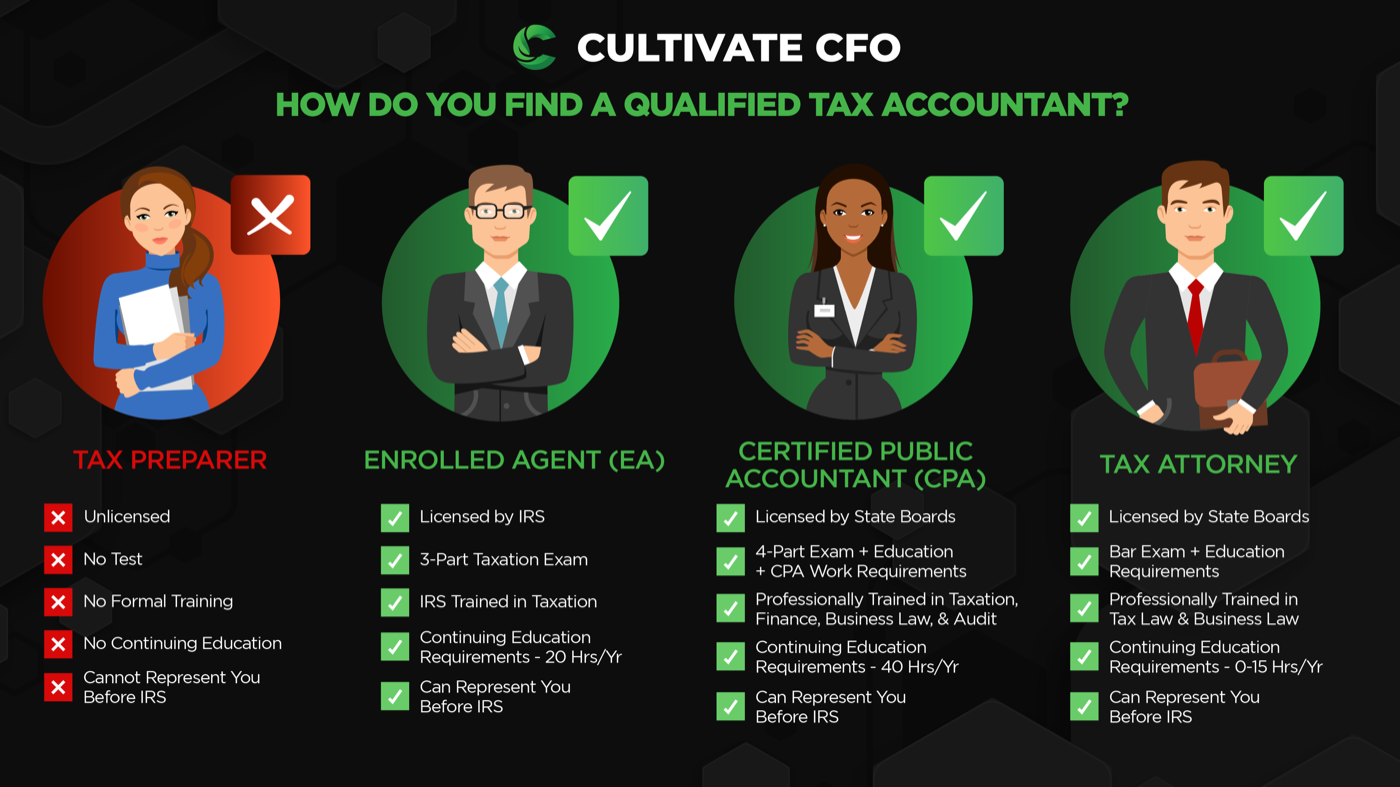
- Enrolled Agent (EA): Licensed by the IRS. They take a 3-part exam focused solely on tax. The have continuing education requirements and can represent you before the IRS.
- Certified Public Accountant (CPA): Licensed by State Boards. Professionally trained in accounting, finance, taxation, business, and audits. Stringent education, experience, and continuing education requirements. Able to represent before the IRS.
- Tax Attorney - Professionally trained attorney who specializes in tax law. Able to provide legal advice and represent taxpayers in civil and criminal tax court before the IRS.
Strategies for Finding the Right Tax Accountant
Here are the steps that I would recommend you take to find a qualified Tax Accountant:
- Referral - Seek recommendations from a trusted professional like your Financial Advisor, Wealth Advisor, Lawyer, or other business owners.
- IRS - Use the IRS’s Directory of Federal Tax Return Preparers with Credentials and Select Qualifications to find preparers with PTINs and IRS-recognized professional credentials.
- Local Search - Google CPAs in your area if you want someone local. Keep in mind that most Tax Preparers work fully online, so you can often choose a Tax Accountant anywhere in the country as long as they are familiar with your State and Local tax filing requirements.
- Check Reviews - Review both positive and negative reviews to determine quality and reliability of potential accountants.
Once you’ve found who you think is a good Tax Accountant, it’s important to also vet them to make sure they are legitimate and confirm that they are the best fit for your situation.
Step 3: Vetting your Tax Accountant
Finding the right Tax Accountant is crucial not only for filing correct returns, but also for peace of mind and financial security. Most of our clients came to us initially just trying to keep the IRS off their back. But those who have stayed with us for years have done so because they found in us a strategic partner in building their wealth.
Remember that as in life, cost often reflects the value and quality of service. But expensive doesn’t mean better in all situations. You should focus on finding the Tax Partner who fits your needs and your budget.
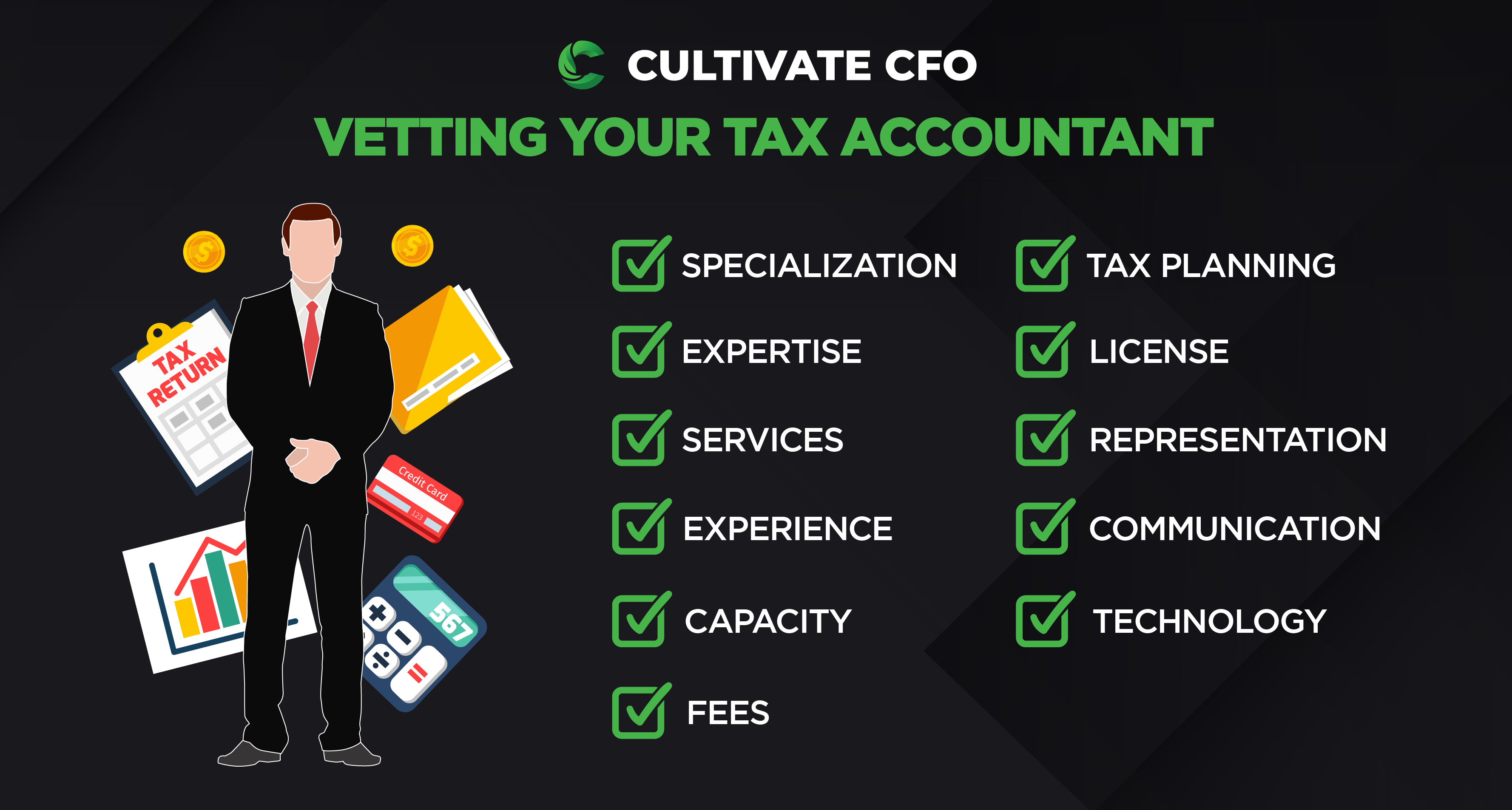
The following is a detailed list of considerations that can make or break your relationship with your Tax Accountant. These include: Specialization, Expertise, Services, Experience, Capacity, Fees, Tax Planning, License, Representation, Communication, & Technology.
Specialization, Area of Expertise
Every CPA is going to have a focus and specialty. Here are some of the specializations you should understand to know how to match your situation with your Tax Accountant’s expertise:
- Tax Planning and Advisory: For those who need strategic tax advising to minimize tax liabilities and build wealth.
- Personal Tax: For those with simpler personal tax filings and need a more cost-effective service.
- Business Tax: For those who need help handling the complexities of business tax filings.
- Non-Profit: Non-profits require a Tax Accountant who understands the complexities of non-profit tax and compliance.
- International & Expatriate: For expatriates or those handling international income, foreign investments, and tax treaty situations.
- Estate & Trust Tax: If you have more wealth, it’s important to have a Tax Accountant who focuses on estate, trust, and gift tax returns and works closely with estate planning attorneys.
- IRS Representation and Tax Resolution: If you’re in an audit, on a payment plan, or have other legal issues, you want to make sure your Tax Accountant will handle IRS representation and resolve audits, disputes, and appeals.
Other Services
If all your Tax Accountant does is tax preparation, you may be left in the lurch and struggle to get the most value out of your relationship. Consider whether you need some of the following services:
- Accounting & Financials Review: Will your Tax Accountant have someone on their team who can review your financials before preparing the returns? Many Tax Accountants simply take your numbers and file as-is, which can lead to massive over- or understatements of income. This can cause huge and expensive tax errors.
- Tax Planning: Does your Tax Accountant actively engage in Tax Planning to help you reduce your tax liability? Learn more in my article Tax Planning vs Tax Preparation if you’re unfamiliar with Tax Planning.
- Estate Planning: Tax preparation and planning often bumps up against estate planning implications. It’s good to have this expertise if you have larger wealth you’re seeking to manage.
- Auditing Services: Larger firms often offer independent audits — including compilation, review, and audit — of financial statements, which is often required by banks and bonding agencies. Keep in mind that your Tax Accountant can’t also be your auditor due to conflict of interest and independence requirements.
- Fractional CFO Consulting: Your Tax Accountant is in a unique position to have great financial insights into your business. If the firm you’re working with also offers Fractional CFO Consulting, you may be in a great position to add CFO insights to help your business make better, more profitable decisions.
Experience: Seasoned or Newbie?
Experience is essential in a Tax Accountant, and there are some complex tax situations that are hard to learn from the book.
Number of Seasons: How many seasons does your Tax Accountant have under their belt? Sometimes there simply isn’t a substitute for experience. At the same time, if your situation isn’t too complicated, you’ll likely get some savings and be fine with a less experienced preparer.
Continuing Education: It’s ok to ask your Tax Accountant what they’ve been focusing on with their Continuing Education. If they aren’t spending much time on tax courses and keeping up with recent tax law changes, you may incur errors in your returns or miss out on new law changes.
Capacity
The standard business model for a tax preparation firm that doesn’t provide other services is to maximize their tax preparation workload for the whole year — not just through April 15th. The reason for this is simple: they’re trying to make a living, and you can’t keep a staff if you only employ them half the year.
What this means for you is that unless you’re a top priority client and get your information in quickly, you’re likely to be put on extension through to September or October. This might put you behind when it comes to making proactive decisions about your tax liability and planning strategies.
Every CPA firm faces this tough balance between the business viability of the firm and caring for clients, so you want to know your place and their prioritization of you in their tax season.
On the other hand, you may be like some of our clients who have K-1s and forms that they normally don’t receive until after the April deadline, so this extension is normal, even if not ideal.
If you find yourself with a Tax Accountant who doesn’t have a lot of clients, you should understand why.
- Are they a boutique firm? If so, you’ll pay higher rates.
- Is it a lifestyle choice where they only work half the year? This might be a good fit as long as you don’t need them for handling tax notices when they’re taking time off.
- Are they a normal firm? If they don’t have a lot of clients, this might not be a good thing.
- Do they also focus on other services like CFO and Tax Planning? This might be an optimal fit if you can also leverage those other services.
Fees
You should also ask about the fee structure and the normal range of fees for tax preparation. Your price will vary, but it’s typically based on the number of hours worked. You should make sure that the amount you pay is an accurate reflection of the value provided.
- A good Tax Accountant should save you more money than they cost.
- An excellent Tax Accountant and Planner could save you significant amounts through good planning.
Important: The tax preparation work involved can double or more based solely on your personal organization and preparation of your financials and tax documents. For most of our clients who’ve felt our bill was high, the issue wasn’t our actual time spent preparing the tax returns, but rather the front-end time we spent organizing documents, building financial statements, and requesting missing forms and information.
Ultimately, you should plan for your fee to match the complexities of your returns. Less experienced Tax Accountants will often cost you far more in taxes than they’ll save you in fees.
Here are some considerations for fees:
- Per the National Society of Accountants 2020–2021 survey, the average hourly rate of CPAs for tax preparation services was $180/hr.
- Most firms will charge a retainer fee.
- Some firms charge a Minimum Fee + Hourly Rate.
- Some firms charge a set fee per form or schedule needed on your return.
- Some firms charge additional fees to file extensions, expedite returns, for tax information received after the deadline, IRS letter/audit responses, etc.
Tax Planning and Tax Savings
Does your Tax Accountant offer an analysis of your specific tax situation to look for ways to help you save on taxes?
Not all Tax Accountants do tax planning. But do they at least understand tax planning? And can they implement all of the tax strategies you’re looking for?
Obviously, a lot of my focus here at Build Wealth Save Taxes is on Tax Planning specifically, so if you want more information on this, check out some of my other articles.
License
The easiest step you can take in vetting is to check licenses — it typically takes just a few minutes online to verify, and the benefit is that you might avoid some real trouble with some of the bad apples out there.
- Verify CPA licenses with the state board of accountancy. You can also see any complaints, disciplinary actions, or suspensions against the CPA.
- Verify Enrolled Agent licenses here.
- You can also verify that your Tax Accountant is registered with the IRS with an active Preparer Tax Identification Number.
Representation
EAs, CPAs, and Tax Attorneys can represent you before the IRS on audits, payments, collections, and appeals. But not everyone is willing to do this, as it’s a specialty in and of itself.
Make sure you know the Tax Accountant’s policy on representation and audits prior to them preparing your return, so that you know exactly what to do if/when you get a notice and what their fees will be for this work.
Communication
When you pay for expert tax preparation, a significant part of the value you should look for is the relationship. As you interview your Tax Accountant, you should probe for their responsiveness and how they help you understand your returns. Here are some good questions:
- Will the Tax Accountant take a phone call?
- How quickly do they respond to your emails?
- Do you have the ability to schedule meetings with them?
- Do you understand them when they explain more complex tax issues and concepts?
- Do they stop and explain your options to you and guide you in your decision-making?
Tech Platform
The last step you need to take is to evaluate what technology they use and how you’ll interact with them. This can be clunky, inefficient, and risk the security of your information — or efficient, secure, and convenient for you. Here’s what you should consider regarding the tech platform:
- Ensure they E-File. The IRS encourages e-filing because it’s more accurate and complete, safer and more secure, provides faster refunds, offers payment options, and is easier.
- What is their tech stack? How do they expect you to communicate with them? Is it easy for you to set up a meeting on their calendar?
- Client Portal: What software are they using for secure file transmission? Do they offer a Client Portal for uploading and viewing documents? Is it easy to access and use? Do they have a phone app?
- Data Security: Are you confident in how they transmit and store your financial data? Do they have strict security policies in place?
- Remote Services: Online and remote services are essential in our post-Covid world. Ensure your Tax Accountant has the infrastructure in place to function fully online.
Once you’ve vetted your Tax Accountant and you’re sure you have a good fit for your needs, you need to take the right steps to build a relationship that will help you get the most value in your engagement.
Step 4: Build a Relationship with Your Tax Accountant
Once you’ve selected and vetted your Tax Accountant, you need to take some time to ensure that your investment of time, energy, and money into this relationship results in strong returns for you — bringing tax savings and optimizing your financial decision-making.
Remember, our goal is to save time, money, and stress, and reduce the chance of an audit. The following are a few small steps you can take to make the most out of this relationship.
Honesty & Transparency
The first thing you need to do is be honest and transparent. Hiding financial information from your Tax Accountant is a recipe for an audit.
You need to provide all the necessary details for your tax preparation. Complete organizers (see below), submit all tax forms, and share all relevant financial information.
Don’t be embarrassed to share your financial dirty laundry. Here’s a secret — your Tax Accountant has seen worse and we’re numb to it. We aren’t making value judgments on your worth or success. We simply need to know the details so we can help you file accurate tax returns and get you where you want to go.
Ask for Advice, Opinions, Ideas
Ask your Tax Accountant for advice on big financial decisions, purchases or sales of assets, or starting or closing a business.
I can’t tell you how many disasters I’ve helped my clients avoid, and how many I’ve heard about after the fact and could only try to help pick up the pieces. You have an asset in this relationship — use it!
Check with your Tax Accountant before implementing business or financial strategies, and ask for their input about ways you can adapt the plans to save on taxes and ensure you avoid negative legal or tax implications.
A short meeting or phone call often saves a lot of unnecessary taxes and headaches down the road.
Share your Plans, Goals, and Vision
Make it a point to share your financial and business goals for the coming years with your Tax Accountant. This will certainly impact the depth and value of the advice you’ll receive, as they can work to adapt your tax liability and strategies around your future goals.
If you’ve done estate planning or financial planning, you need to share these plans with your Tax Accountant, even if only at a high level. You don’t want them unknowingly undermining these plans through the tax positions you take.
Schedule Quarterly Meetings
Regular review meetings with your Tax Accountant can help you assess financial progress, discuss real-time changes in your finances, and adjust strategies proactively. The goal here is to gain real-time insights and advice, not just after-the-fact suggestions that you can’t act on. We find that the quarterly call is the best cadence throughout the year for optimizing value and cost.
Once you’ve shared this information with your Tax Accountant and built this relationship, your next responsibility is to prepare for your tax engagement.
Step 5: Prepare for Your Tax Engagement
For you to successfully engage a Tax Accountant to assist you with your returns, you need to compile all of your tax documents and information and supply them to the Tax Accountant in an orderly and timely manner.
💡 Key Idea: Your Tax Accountant can’t prepare what you don’t provide them.
Here’s a short list of how you can prepare for your tax engagement:
- Review checklists (see downloads below)
- Complete your Tax Organizer (see downloads below)
- Gather your tax statements (e.g., W-2, 1099, K-1s)
- Gather your expense documentation (e.g., receipts and statements for itemized deductions, medical expenses, tax payments, and health statements)
- Gather recent IRS or State notices, audits, or communication
- Provide identification documentation, including driver’s license and social security numbers for each family member
- Provide copies of your prior two years’ tax returns
- Business financials, trial balance report, bank/liability statements, W-3, and QuickBooks or accounting software access
I highly recommend reviewing the downloads below, as they go much more in-depth and can be helpful in more complex tax engagements.
Step 6: Understand Important Deadlines
Not only do you need to provide the right information, but you also need to do so in a timely manner so that you can get your returns completed on time.
We provide the following deadlines to our clients to ensure they know when they need to provide their tax information in order to complete their returns on time. Our internal deadline for having all information to us in order to complete the returns by the deadlines is 30 days prior to the deadline. So if a business return is due on March 15th, we require that all the necessary information be supplied by February 15th.
These deadlines remain fairly consistent year to year if you’re reading this article in subsequent years.
- January 15: Q4 estimated tax payments due
- January 23: Start of tax season; IRS begins processing tax returns
- January 31: Deadline to submit W-3/W-2 and 1096/1099 forms
- March 15: Deadline for Partnerships and multi-member LLCs to file Form 1065, and for S Corporations to file Form 1120S
- April 1: Required minimum distributions due for individuals who turned 73 in the prior year
- April 15:
- Deadline for individuals to file Form 1040 and C Corporations to file Form 1120
- Q1 estimated tax payments due
- Deadline for filing a six-month extension
- Deadline for 1040 tax payments
- Deadline to make IRA and HSA contributions for the prior tax year
- June 15: Q2 estimated tax payments due
- September 15:
- Q3 estimated tax payments due
- Extension deadline for Partnerships and multi-member LLCs to file Form 1065, and for S Corporations to file Form 1120S
- October 15: Extension deadline for individuals to file Form 1040 and C Corporations to file Form 1120
Tax Preparation Checklists
To make preparing for your tax engagement easier, download the checklist that fits your situation:
Tax Preparation Organizers
A tax organizer walks you through gathering everything your Tax Accountant needs, section by section. Use the short version for simpler filings or the long version for more complex situations:
Was this article and its resources helpful for you in preparing your tax returns this year? Please share it so that others can learn how to be more strategic with managing their tax preparation.
Questions or further thoughts? Feel free to drop them in the comments and we can dive deeper!
One idea a week toward owning your tax strategy.
Launching soon — issue #001 lands in your inbox the day it ships. You'll also hear occasionally about my tax-planning workshops. Unsubscribe any time. Privacy